
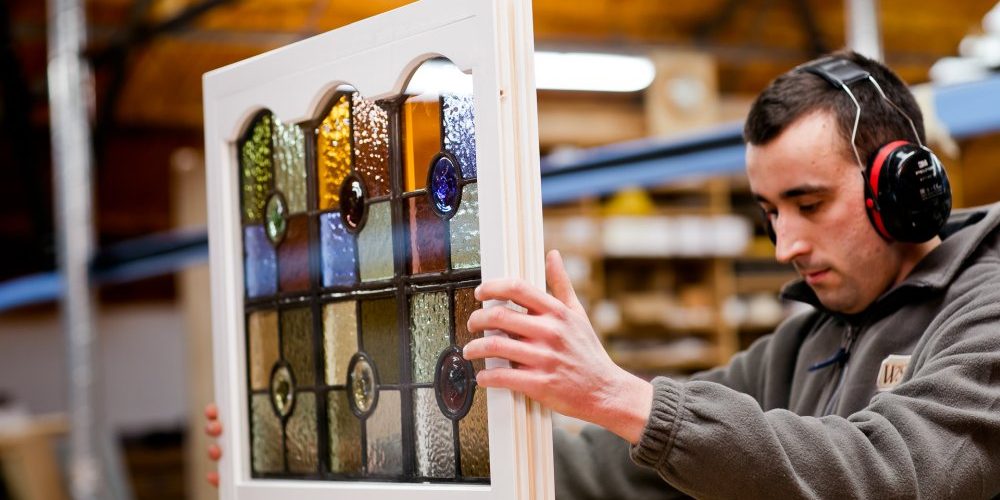
If you have ever wondered how stained glass windows are made, the answer is both simple and intricate. At its heart, stained glass is still a hand-built craft. The materials are familiar enough: glass, lead, solder, paint and the timber joinery around it, but the skill lies in how those parts are designed, cut, assembled and protected so they last.
That is one reason stained glass still feels special in period homes. Whether it appears in a front door, stairwell, sash window or new French doors opening onto a garden, each panel is made piece by piece rather than produced to a standard pattern.
For homeowners, there is often a second question alongside the craft one: How do you make stained glass windows in a way that still suits modern comfort, security and insulation? It is not only how stained glass is made but also how that old craftsmanship is combined with modern comfort, security and insulation. The stained glass panel itself may still be made in the traditional way, while the finished window or door around it is built for modern living.
In this guide, we explain the process from design to finished panel, including how painted details are fired into the glass and how modern double-glazed stained glass units are assembled for new windows and doors.
It starts with the design
Before any glass is cut, the design has to be worked out properly.
Historically, a designer or craftsperson would draw the pattern by hand, often taking cues from the age of the building and the style of the surrounding joinery. That still happens now, although homeowners often begin by gathering inspiration images. A Victorian house may suit a more geometric arrangement, while an Edwardian property may lean towards lighter floral forms.
Once the direction is agreed, a full-size working drawing is produced. It maps out every piece of glass, every lead line and every painted detail and becomes the guide for the build.
This stage matters more than many people realise. Good stained glass is not only about colour. It is also about proportion, balance and how the design reads from inside and outside the house in different light.
The materials and tools used in stained glass
Traditional stained glass panels rely on a small set of materials, each with a specific job to do.
The main materials are:
- Coloured or textured glass, chosen for tone, transparency and character
- Lead came, the grooved strips of lead that hold the glass pieces together
- Solder, used at the joints where the lead meets
- Specialist cement, used to weatherproof and strengthen the finished panel
- Glass paint and stains, where shading, linework or decorative detail is needed
A craftsperson will usually use a full-size pattern, a glass cutter, tools for shaping and trimming pieces, brushes for painted details, a kiln for firing, and soldering equipment for assembling the leadwork.
How to make stained glass windows, step by step
1. Selecting the glass
Once the design has been finalised, the maker chooses the glass for each section of the pattern. This is not simply a matter of matching colours. Texture, density, opacity and the way the glass reacts to daylight all matter too.
Some pieces are chosen for the depth of colour. Others are chosen because they catch the light softly or give a slight ripple to the view beyond. If the design is being made to suit an existing property, the selected glass may also need to sit comfortably alongside original joinery, paint colours and brickwork.
2. Cutting each piece to shape
Each shape from the working drawing is cut from the chosen sheet glass. The craftsperson scores the surface and then breaks it carefully along the line, refining the edges as needed so the piece sits properly within the lead.
Because a stained glass panel is built from many small parts, each cut piece needs to be accurate. The tighter the fit, the cleaner the finished panel.
3. Painting details onto the glass
Not every stained glass panel includes painted work, but many of the most striking ones do. Painted details can add outlines, shading, foliage, lettering or soft tonal transitions that cannot be achieved through coloured glass alone.
The paint is applied by hand to individual pieces before the panel is assembled. Once painted, the glass goes into a kiln so the pigment fuses permanently to the surface. Without that firing stage, the decoration would not have the durability needed for a working window or door.
4. Leading the panel together
Once all the glass pieces are cut, and any painted ones have been fired, the panel can be assembled.
Each piece of glass is fitted into grooved strips of lead known as lead came. These strips form the framework of the panel. The lead is soft enough to be shaped around the pattern, but strong enough to hold the panel together once everything is assembled correctly.
The glass does not simply sit edge to edge. It is held within a matrix of lead, and that lead shapes both the structure and much of the final look.
5. Soldering the joints
Where the lead sections meet, the joints are soldered. This locks the framework together and gives the panel its strength.
Soldering needs to be neat and consistent. Poor soldering will not only look untidy, it can also affect the reliability of the panel over time.
6. Cementing and weatherproofing
After soldering, the leadwork is cemented. The cement is worked into the lead joints and around the glass to help seal the panel against the weather and stiffen the structure.
At this point, the traditional stained glass panel is complete as a single-glazed unit. For centuries, that would have been the finished product, and in many older properties, that is still exactly what you will find today.
How modern double-glazed stained glass units are made
Traditional stained glass has enormous character, but homeowners today usually want more from a window or door than appearance alone. They want warmth, reduced draughts, better durability and a more practical day-to-day result.
That is why many new stained glass windows and doors now use encapsulated units.
The stained glass panel itself is still made using the same traditional methods described above, so the craft behind making a stained glass window remains largely unchanged. The difference is what happens around it once the leaded panel has been completed.
Instead of finishing the outer edge in the standard way, a specialist Y-section lead is often used around the perimeter. This allows spacer bars to sit on either side of the stained glass panel, which is then positioned centrally between two panes of clear glass.
Modern double-glazed stained glass is therefore usually triple-layered in practice: the stained glass panel in the middle, with a sheet of clear glass on either side. The sealed unit is assembled in controlled conditions to reduce the risk of dust or contamination being trapped inside.
The result is a decorative unit that keeps the look and craftsmanship of traditional stained glass while protecting the leadwork from direct weather exposure. It also improves thermal performance compared with older single-glazed stained glass panels.
Why complexity affects cost and lead time
Every stained glass panel is bespoke. That means the pattern, number of pieces, amount of painted detail and installation method all influence the time and cost involved.
A simple design with larger pieces of glass is quicker to produce than a dense, highly detailed panel with lots of cutting, painting and intricate lead lines. Replicating an existing design can sometimes speed up the design stage, while creating something entirely new may take longer because there is more discussion, drawing and refinement before manufacture begins.
That is why stained glass should be treated as a craft process rather than an off-the-shelf product. The finished result depends on skilled hands at every stage.
Traditional craft, modern joinery
At Wandsworth Sash Windows, stained glass is often only one part of the wider job. The surrounding joinery matters just as much.
Some clients want completely new stained glass built into brand new windows or doors. Others want to keep the original stained glass from an older property and have it carefully reused within newly made joinery. Both approaches can work well when the project is planned properly.
If the existing glass is worth keeping, it can often be removed, encapsulated within new double-glazed units and fitted into new joinery. If the glass is missing, damaged beyond sensible repair or the client wants a fresh design, new panels can be made to suit the property from scratch.
That flexibility is especially useful in period homes where character matters, but so does comfort. It is also why many homeowners looking at replacement sash windows ask us about stained glass at the same time.
Project example: new stained glass in bespoke French doors
A good recent example is a project on Clissold Crescent in Stoke Newington, N16, an area known for Victorian and Edwardian houses where rear extensions often open onto gardens.
For this property, we supplied and installed a bespoke timber French door set made up of three sections: a central opening door with two fixed glazed side panels. The arrangement created a wider, brighter opening onto the garden and strengthened the connection between the kitchen and the outside space.
The distinctive feature was the stained glass in the upper sections of the doors and side panels. These were newly made panels created specifically for the project, then encapsulated within double-glazed sash windows so that the client could enjoy the decorative effect alongside modern insulation and durability.
Externally, the joinery was finished in a deep green paint colour. The result was a set of doors that brought in more light, improved access and added a decorative focal point without feeling out of place.
As a guide, a project of this type came in at around £8,000 to £9,000 for the bespoke timber French door installation, excluding the cost of the new stained glass itself.
Project example: keeping original stained glass in new sash windows
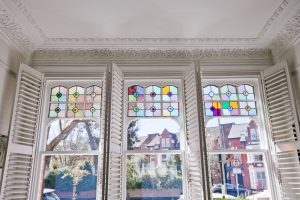
A different approach was used on Greencroft Gardens in West Hampstead, NW6, where the priority was to retain the original stained leaded glass while improving the performance of the windows.
On this project, we carried out our sash replacement service on the front first floor, installing three new pairs of timber sash windows into the existing box frames. Keeping the box frames helped retain the building’s established appearance while allowing the new sashes to be double-glazed and fully draught-sealed.
The original stained glass from the upper sashes was carefully removed and sent for encapsulation within new double-glazed units. Those completed units were then fitted into the new upper sashes before installation.
This approach preserved the look of the original decorative glass while giving the homeowner the benefits of new timber sashes, smoother operation, less draughtiness and improved overall performance.
As a rough guide, this project cost around £5,000 to £6,000 for the three pairs of new timber sash windows installed into the existing box frames, excluding the specialist encapsulation work.
See all of our case studies.
Thinking about stained glass for your own home?
Stained glass combines design, craftsmanship and technical know-how in a way few other window details can. Whether you are interested in how stained glass windows are made or weighing up a project of your own, the appeal lies in that mix of artistry and precision. Whether you are simply curious or planning a project, the process comes back to the same fundamentals: strong design, accurate cutting, careful leading, neat soldering and the right installation method.
If you want to introduce stained glass into new windows or doors, or you would like to preserve existing stained glass within newly made joinery, we can help you work through the options.
From bespoke new designs to replacement sash windows that retain period character, the goal is always the same: a result that looks right, works properly and feels at home in the property. If you are planning a project and want to talk through designs, glazing options or whether existing stained glass can be reused, get in touch with us and we will help you find the right route.